73%
EU SMEs with at least basic digital intensity, still below the EU 2030 target.
Having tools is not enough if the process stays fragmented.
Source: Eurostat Digitalisation in Europe 2025
Centralize information, simplify operational actions, and automate the manual handoffs that create errors, chasing and delays today.
stAItuned turns operational processes managed across spreadsheets, email and chat into unified, traceable workflows ready for action.
One flow
No scattered files or uncontrolled copies
Tracked handoffs
Requests, approvals and states always visible
Close without chasing
Reconciliation ready before export
Why this problem matters
Many SMEs still run on fragmented processes, disconnected tools and manual coordination.
73%
Having tools is not enough if the process stays fragmented.
Source: Eurostat Digitalisation in Europe 202576.1%
The gap is not just software adoption, but linking roles and data in one flow.
Source: Digital Decade 202460%
When statuses are not shared, time goes into chasing instead of operational closure.
Source: McKinsey High Tech PracticeWhen data, requests and approvals live in different places, work does not scale. It fragments.
Does this sound familiar?
Hours, leave requests and supporting files arrive through chat, email, calls and voice notes.
Admin and managers work on different copies and nobody knows which one is current.
Hours, absences and approvals diverge across systems and control arrives late.
Issues show up only at the end of the month, when payroll, reporting or job costing must close.
How we already translated this into a concrete flow
One concrete case, readable in seconds: first the breakpoints, then the same process rebuilt into one shared system.
Before
Hours, absences, approvals and checks move across apps, spreadsheets, chat, email and manual exports.
After
The same process runs in one flow, with synced data, tracked states and outputs already ready.
Before vs after
First the breakpoints. Then the same flow, already rebuilt.
Current state
As-is flow mapping. Red nodes mark the manual handoffs and unstructured channels that create bottlenecks and a high reconciliation error risk.
Mobile version of the current flow
Where the flow breaks
Workflow demo
Select a role and see only the screens and actions that matter to that person.
Real screenshots
Operator view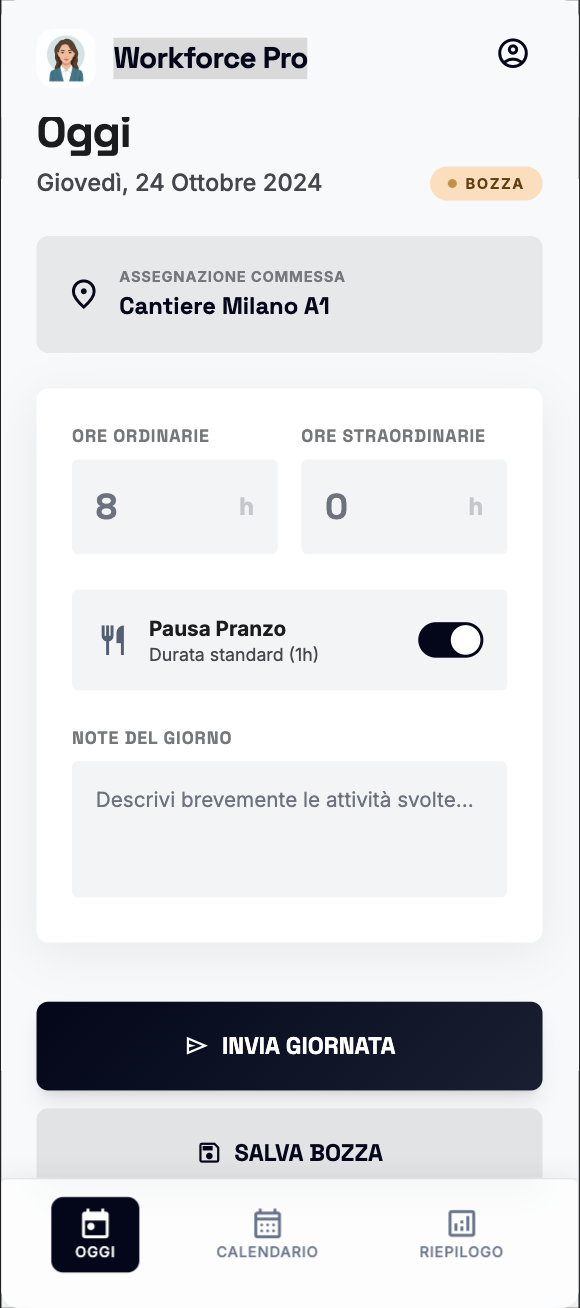
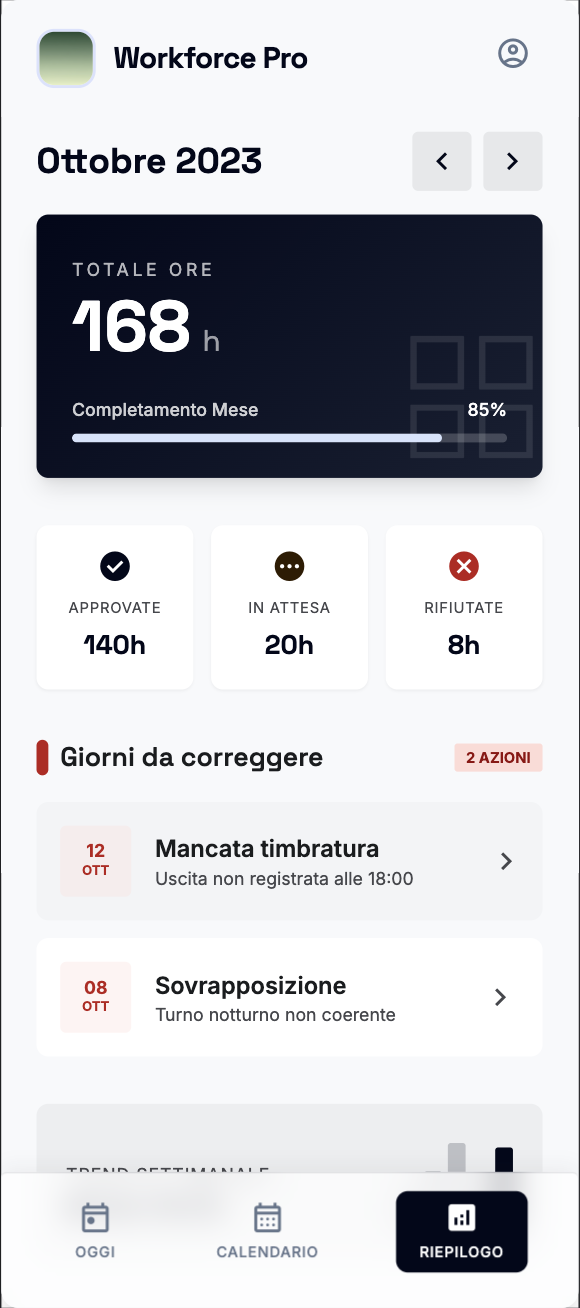
Role-based view
The worker submits time, notes and attachments from mobile without relying on chats, sheets or manual relays.
Where we apply it
What you saw is not limited to one department. The value is in the pattern: scattered requests, approvals outside the flow, duplicated data, and control that arrives too late. If you recognize these signals in another process, we can work on that too.
Signals that the issue is not only HR/Admin
Do you have a process that is wasting time in manual steps, chasing and context rebuilding? That is exactly the kind of workflow we start from.
Collects hours, jobs, notes and support files in one flow before monthly close.
Replaces informal approvals with explicit steps and searchable history.
Centralizes missing files, signature requests and admin validation.
Keeps the same workflow logic when managers and admin work across locations.
Would you like to try this use case in your company?
Do you have a different process where you want to test this approach?
Demo request
Submit this request and I will come back with a demo tailored to your case, not a generic intro call.
A few details are enough to understand whether the workflow should be modeled around this use case or a different one.
Operational impact
Directional improvement signals for workflows still managed across apps, spreadsheets, messages and manual handoffs. Actual values depend on the starting level of fragmentation.
The team stops rebuilding the picture from disconnected files and sources.
Requests, approvals and checks move inside the same flow.
Admin and managers see earlier where the process is getting stuck.
The output arrives already structured, with less manual cleanup.
FAQ
We start from the HR/Admin demo already validated and adapt it to your real process: fields, roles, statuses, approval rules and final outputs.
No. The first goal is to remove friction from manual handoffs. We can start with one scoped workflow and connect it later to the tools you already use.
Workers submit data and attachments, managers approve or correct, and admin controls exceptions, blockers and the final export.
The goal is to show a working workflow quickly, using data and screens that reflect the real operational process of your company.
Demo finale
In 20 minutes I can show how this flow would work in your case.
No theoretical deck. We start from your current process, identify where it breaks, and show how to centralize it.
Nessuna call generica: partiamo dal processo che vuoi rivedere e dal punto in cui oggi si spezza.