

The $6.5 Billion Piece of Paper: Why Logistics is the Final Frontier for AI Agents
FREESupply chain executives, logistics providers, and AI engineers focused on vertical-specific automation and unstructured data processing.
An intelligent document processing architecture that uses Large Language Models as reasoning engines to extract, classify, and validate data from unstructured documents based on semantic meaning rather than fixed coordinates.
Logistics AI: The $6.5 Billion Opportunity
Transition from brittle template-dependent OCR to semantic AI agents to bridge the $6.5B gap in logistics documentation.
DCSA estimates switching away from paper Bills of Lading could save $6.5B in direct costs.
Ocean carriers issue around 45 million Bills of Lading annually; In 2021, only 1.2% were electronic.
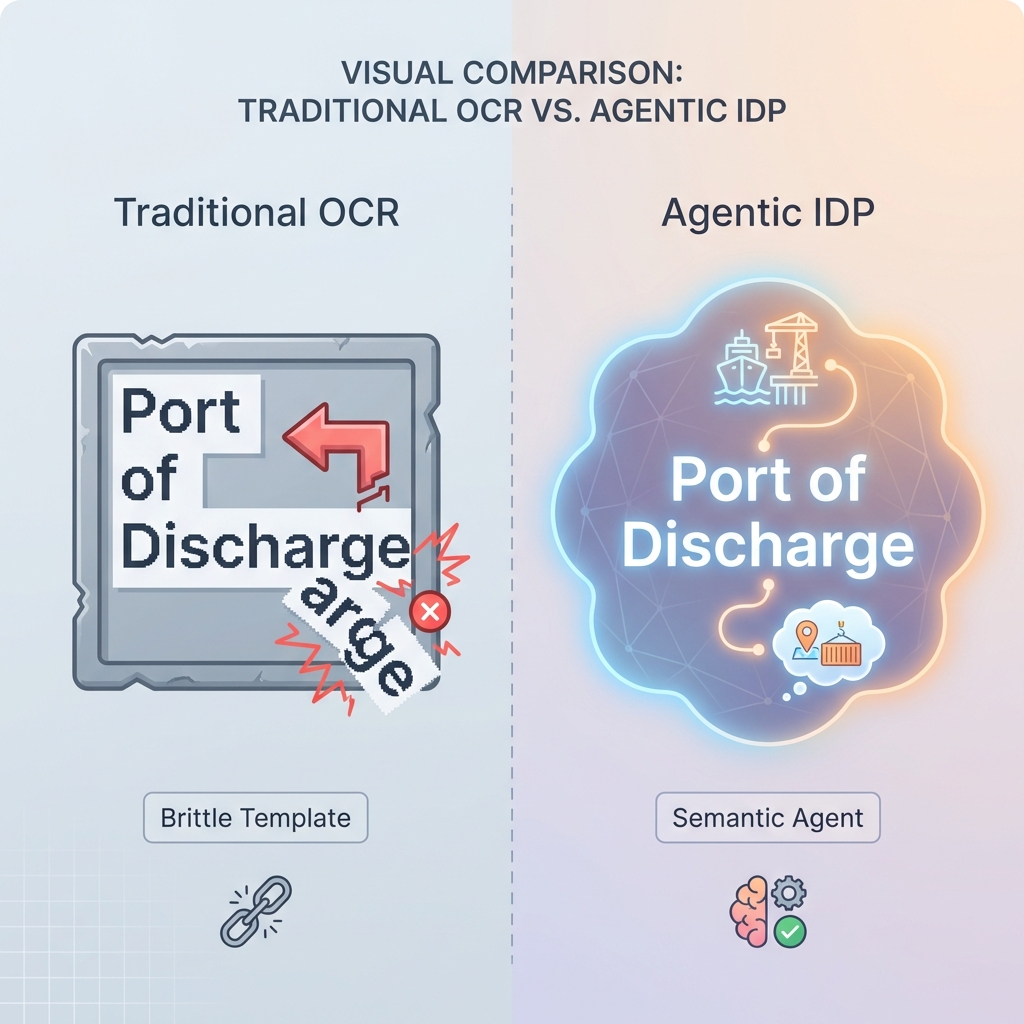
Traditional OCR (Soldier) fails on layout shifts; Agentic IDP (Agent) uses semantic reasoning to handle unseen formats.
Reliability is achieved through multi-layered validation and Confidence Gating, moving humans to high-value exception management.
If you want to build a unicorn, stop looking for problems in Silicon Valley coffee shops and start looking at a shipping container. While the AI world is obsessed with generative art, the global supply chain is bleeding cash due to a problem that looks incredibly boring but is incredibly expensive: Paper.
Strategic Pillars for Logistics AI Implementation
Reliable document automation in logistics goes beyond simple OCR. Here are the core principles to ensure your agentic workflows succeed:
- Context-Driven Extraction: Prioritize semantic understanding over fixed pixel coordinates to handle layout drift across different carriers.
- Lifecycle Auditing: Focus on documents where errors cause the most friction, such as those triggering customs holds or demurrage fees.
- Intelligent Gating: Use confidence thresholds to route low-scoring extractions to human experts (HITL), maintaining 100% data integrity.
- Deep Validation Layer: Supplement extraction with deterministic checks (Regex, ISO standards) to prevent hallucinations in critical numbers like container IDs.
- Iterative Scaling: Master the "Happy Path" of standard formats first before addressing the complex "Long Tail" of regional exceptions.
Quick Glossary
| Acronym | Meaning |
|---|---|
| B/L | Bill of Lading |
| eBL | electronic Bill of Lading |
| STP | Straight-Through Processing |
| HITL | Human-in-the-Loop |
Why Logistics is the Final Frontier for AI Agents

The backbone of global trade still runs on PDFs, email attachments, and Excel sheets. DCSA estimates switching away from paper Bills of Lading could save $6.5B in direct costs [1].
For an AI Builder, this is the "Golden Ratio" of opportunity: A massive market drowning in unstructured data—around 45 million bills of lading are issued per year, yet In 2021, only 1.2% were electronic. The shift to Agentic IDP redefines Logistics AI, moving from passive scanners to proactive agents that can reason about shipping context and support the industry's 2030 commitment to 100% eBL adoption.
The industry is recognizing that fully digitizing the Bill of Lading could save staggering sums—estimated at $6.5 Billion annually when reaching full adoption [1].
Regulatory Tailwinds: Legal recognition of electronic trade documents is advancing rapidly. The UK's Electronic Trade Documents Act 2023 received Royal Assent in July 2023 [3], a landmark move reducing the legal friction for eBL adoption globally.
From PDF to ERP: The Architecture of Agentic IDP
Production-grade systems differ from "toy projects" by their architectural robustness. We treat the LLM as a reasoning engine, not a creative writer.
The Executive View: 4 Blocks of Value
- Intelligent Ingestion: Identifying document types (B/L, Invoice, Packing List) without manual sorting.
- Semantic Extraction: Understanding fields based on context, not just coordinates.
- Deterministic Validation: Applying business rules (Regex, UN/LOCODE) to ensure data sanity.
- Confidence Gating: Automatically approving high-confidence cases (STP) while routing edge cases to experts (HITL).
The Technical View: Pipeline Detail
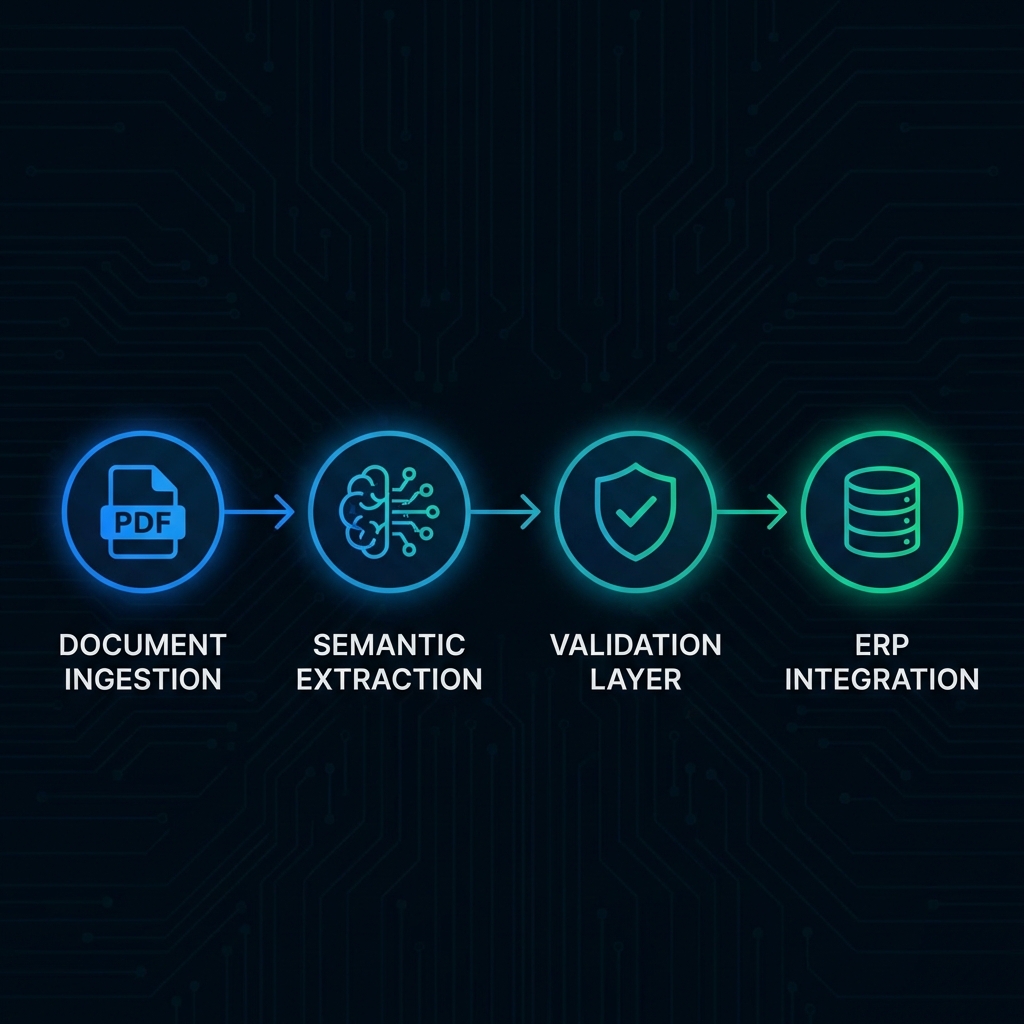
The pipeline ensures that data is not just "read" but "verified" before hitting the core database:
- OCR/Vision: Extracting raw text and visual layout tokens from the PDF or image.
- Semantic Mapping: Using multimodal LLMs to extract fields by meaning (e.g., "POD" vs "Port of Discharge").
- Business Rule Engine: Performing checksums on container IDs (ISO 6346) and verifying port codes against a master database.
- STP vs. HITL Gating: Implementing a threshold-based routing system to maximize efficiency while maintaining ERP-grade integrity.
Macro case: GenAI-driven automation can unlock large productivity gains across back-office workflows [2].
The Strategic Shift: Context Over Templates
Traditional OCR is a "Soldier" (Deterministic). It relies on fixed templates. When a freight forwarder moves the "Port of Discharge" by an inch, the Soldier breaks.
| Feature | Legacy OCR (Soldier) | Agentic IDP (Agent) |
|---|---|---|
| Logic | Template-based (Coordinates) | Semantic-based (LLM Reasoning) |
| Maintenance | Costly manual adjustments for layout drift | Self-correcting / Context-aware |
| Accuracy | High on known templates, 0% on new ones | High generalization on "unseen" formats |
| Operational Goal | Data Entry Automation | Exception Management (HITL) |
Agentic IDP uses semantic understanding. It knows what a port is regardless of where it sits on the page. This shift from "reading coordinates" to "reasoning about trade documents" allows for ERP-grade integrity while maximizing STP on the happy path.
Unit Economics in 60 Seconds
Executives love automation, but CFOs love spreadsheets. Here is the mini-formula to determine if your logistics agent is worth the investment:
| Variable | Description | Value (Worksheet-ready) |
|---|---|---|
| X | Total Volume (B/L per day) | [Your Volume] |
| Y | Manual Cost per doc (Minutes × Hr Rate) | [Your Cost] |
| STP | Target Straight-Through Processing rate | 70–85% |
| Review | Review cost per exception (Minutes × Hr Rate) | [Your Review Cost] |
| Benefit | (Manual avoided + Error avoided) - (LLM + HITL ops) | Target ROI |
Pro Tip: In logistics, the "Error Tax" (correction costs, demurrage fees, customs holds) often outweighs the direct labor savings.
Worked Example (Illustrative)
Assumptions: €35/hr labor rate, 8 min manual handling, 3 min exception review, €50 avg error fee.
- Volume: 2,000 B/L per day.
- Manual Baseline: 8 mins/doc at €35/hr = €9,333/day.
- Agentic Path: 80% STP (automated) + 20% exceptions (3 mins review).
- New Cost: €1,400 (Review labor) + €200 (LLM/Infra) = €1,600/day.
- Daily Savings: €7,733 (plus a range of €500–€2,500 in avoidable "Error Tax" fees).
Evaluating Success in Logistics Automation
To move beyond the pilot phase, you must track the metrics that CTOs care about:
- Straight-Through Processing (STP) Rate: Target >80% for standard documents by Day 90.
- Field-Level F1 Score: Precision and recall for critical fields. Target >98% by Week 6.
- False Escalation Rate: The cost of bothering a human. Establish baseline by Week 2.
Key Takeaway: If you can’t measure the accuracy of a container ID down to the last character, you haven't built a logistics solution; you've built a demo.
Buy vs. Build: The Executive Decision Matrix
| Approach | When to Choose | Integration & UX | Trade-off |
|---|---|---|---|
| Vendor IDP | Standard formats, speed is priority | Ready-made API, limited UI control | Per-page fees, layout constraints |
| System Integrator | Complex legacy ERP ecosystem | Deep TMS/ERP hooks, custom HITL UI | High upfront CAPEX, vendor lock-in |
| Build In-house | Logistics is your core competency | Total control over pipeline & data | Highest R&D cost, requires AI talent |
Risk & Compliance: Enterprise AI agents require strict governance. Avoid passing sensitive shipper data into generic prompts without mapping specific PII/PHI rules. Ensure your pipeline defines clear data retention policies and RBAC (Role-Based Access Control) for the Human-in-the-Loop interface.
The "Long Tail" Trap and Other Pitfalls
The biggest mistake is trying to automate 100% of documents on day one. Global logistics has a massive "Long Tail" of weird, regional, and handwritten formats.
- Pitfall: Relying on 'zero-shot' LLM extraction without a verification script for numbers.
- Pitfall: Rebranding legacy OCR as "AI" without adding reasoning or validation capabilities.
True value comes from systems that handle the Happy Path with extreme reliability and gracefully delegate the "Chaos Path" to human experts [2].
The 30-60-90 Day Logistics AI Playbook
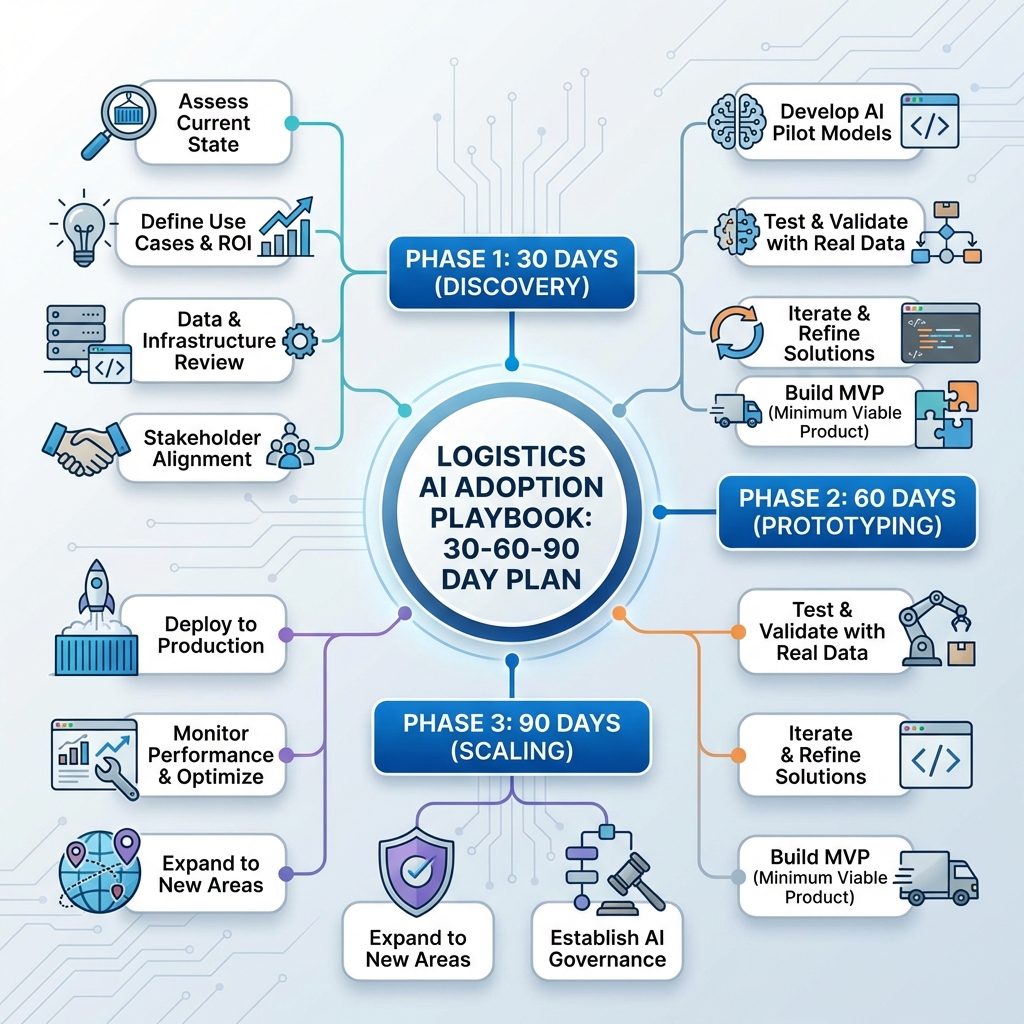
Days 1-30: Audit & Baseline
Identify the document that requires 15 minutes of human attention. Baseline the manual labor cost and the "Error Tax" (customs holds and fees).
Days 31-60: Prototyping & Gating
Build the semantic extraction pipeline. Implement the Validation Layer first—before the LLM integration—to define what "correct" looks like.
Days 61-90: Scale & Integrate
Integrate the pipeline into the TMS or ERP. Shift the human staff from data entry to Exception Management.
FAQ
Why not just use legacy OCR providers like ABBYY?
Legacy OCR requires templates for every new vendor. Agentic IDP uses semantic understanding, handling layouts it has never seen before (Zero-Shot) and drastically reducing maintenance costs.Are LLMs accurate enough for critical shipping numbers?
Not alone. The LLM extracts the data, but a deterministic Validation Layer (Regex, math checks) must verify it before it touches the ERP.What is the ROI of digitizing a single Bill of Lading?
Beyond saving 15 mins of labor, it prevents "Correction Costs" which can scale into hundreds of dollars in port storage fees (demurrage) due to document errors.References
- DCSA (2023). Member carriers commit to a fully standardised electronic Bill of Lading by 2030.
- McKinsey & Company (2023). The economic potential of generative AI: The next productivity frontier.
- DCSA (2023). The electronic trade documents act received royal assent in the UK.
Further reading
Document layouts vary across vendors and forwarders
Prioritize Agentic IDP over traditional template-based OCR.
Data accuracy for container numbers or weights is critical
Implement a deterministic Validation Layer after extraction.
Confidence in AI extraction is below 95%
Route the document to a Human-in-the-Loop (HITL) queue.
Attempting to automate 100% of document types on Day 1.
Start with high-volume, standard documents (Happy Path) and use HITL for exceptions.
Treating the LLM as a creative writer rather than a reasoning engine.
Enforce JSON schemas and use deterministic checks for all numerical fields.
Overlooking the unit economics of manual documentation fees.
Baseline the 'Correction Cost' per error to justify the ROI of agentic automation.